
HIFU and thread lift: how they differ and what to ask
HIFU uses focused ultrasound with nothing inserted; a thread lift places dissolvable threads under the skin. How each works, who they are usually discussed for, and the questions to ask the clinician before you decide.
Author: CNR AestheticsPublished 6 min read
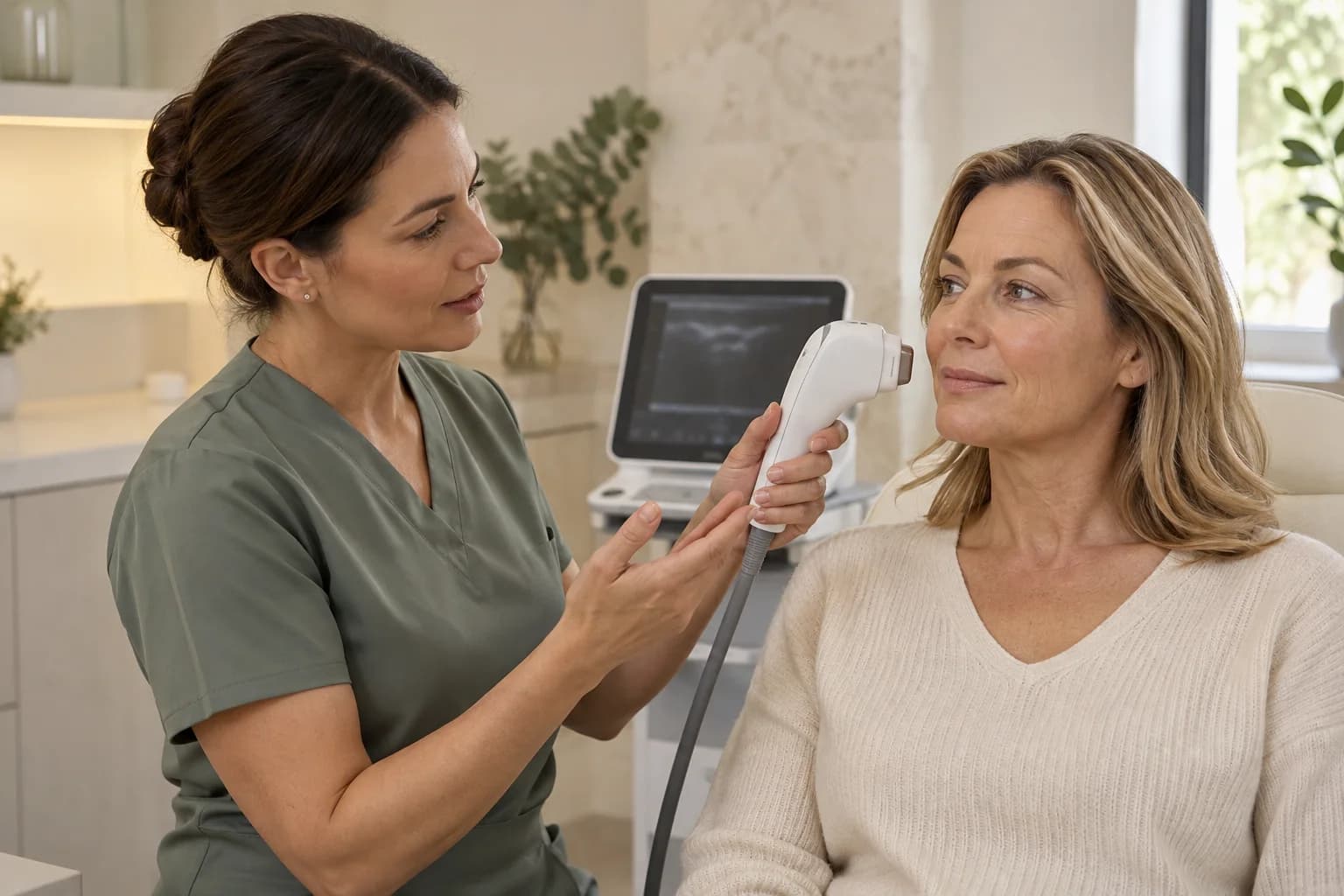
HIFU and thread lifts are both discussed for skin laxity in the face and neck, but they work in different ways. HIFU uses focused ultrasound energy delivered through the skin, with no incisions or implanted material. A thread lift places dissolvable threads beneath the skin with a needle or cannula, so it is a minimally invasive procedure. Which one, if either, suits you is a decision for the clinician carrying out the procedure after an in-person assessment.
This guide explains the mechanism of each, the situations in which they tend to be discussed and the questions worth asking. It does not compare results, because responses vary between individuals and depend on factors only a clinician can assess. We coordinate appointments with independent partner clinics in Istanbul; we do not carry out procedures.
How HIFU works
HIFU stands for high-intensity focused ultrasound. A handpiece placed on the skin focuses ultrasound energy at set depths beneath the surface, creating small points of heat in deeper layers while the surface is left intact. The idea behind the procedure is that this controlled heating prompts the tissue to produce new collagen over time, which is why any change is described as gradual rather than immediate.
Because nothing is inserted, there is no material left in the skin. People may feel heat or discomfort during the session, and some notice temporary redness, swelling or tenderness afterwards. The clinician should explain what to expect for you and which device is used.
How a thread lift works
In a thread lift, the clinician inserts fine threads under the skin, usually after numbing the area with local anaesthetic. The threads are made from materials that the body gradually breaks down, such as polydioxanone (PDO). Some threads have small barbs or cones designed to hold and reposition soft tissue; others are smooth and are used mainly for their effect on the skin around them. The presence of the thread is also thought to stimulate a tissue response as it dissolves.
Because the skin is entered, a thread lift carries the considerations of any minimally invasive procedure: bruising, swelling, tenderness, a feeling of tightness, and less commonly visible or palpable threads, dimpling or infection. The clinician should explain these and how they would be managed.
Who each is usually discussed for
The concern being addressed, the quality of the skin and how much laxity is present all influence which approach a clinician raises. In general terms:
HIFU is often discussed for mild to moderate laxity, for example along the jawline, under the chin or around the brow, by people who prefer to avoid anything being inserted under the skin.
A thread lift is often discussed where some repositioning of soft tissue is the aim, such as the mid-face or jowls, and where a person accepts a minimally invasive procedure.
Significant laxity or excess skin may lie outside what either non-surgical approach is intended for, and a clinician may say so or suggest a surgical opinion.
Some people are not suitable for either, for example because of certain medical conditions, active skin infection or pregnancy; the clinician will review your history.
These are broad patterns, not rules. A clinician may suggest one, a combination, a different approach or nothing at all.
Questions to ask about HIFU
If HIFU is suggested, you may want to ask:
Which device will be used, and can its name be written down for you?
Which areas and depths are planned, and why?
What sensations are typical during the session, and is anything used to make it more comfortable?
When does the clinician usually assess any change, given that collagen changes develop gradually?
Is more than one session discussed, and how far apart?
Questions to ask about a thread lift
If a thread lift is suggested, you may want to ask:
Which type of thread is proposed, what is it made of, and what is the product name?
How many threads are planned, where will they be inserted, and what anaesthetic will be used?
What should you avoid afterwards, such as wide mouth opening, facial massage or heavy exercise, and for how long in your case?
What would happen if a thread became visible or uncomfortable, and who would manage that once you are home?
How does flying soon after the procedure fit with the clinician's aftercare advice?
Planning around a trip
Recovery needs differ between the two, so it helps to know which is being considered before fixing travel dates. A thread lift involves more aftercare to plan around, and the clinician may want to see you again before you fly. With HIFU, any change develops over time, so the appearance on your last day in Istanbul is not the point at which it is judged. Ask the clinician for written aftercare instructions in a language you read comfortably, and keep a record of the device or thread product used.
Does HIFU involve any needles or incisions?
No. HIFU delivers focused ultrasound energy through the skin from a handpiece placed on the surface. Nothing is inserted, although the session can cause heat or discomfort.
Do thread lift threads stay in the skin?
The threads commonly used in aesthetic thread lifts are made from materials the body gradually breaks down. Ask the clinician which material is proposed and what that means for you.
Can HIFU and a thread lift be combined?
Some clinicians discuss combining approaches, or using them at different times. Whether that makes sense for you, and in what order, is a question for the clinician carrying out the procedure.
How do I know which approach suits me?
There is no general answer. The two work differently and are discussed for different concerns, and individual responses vary. The clinician should explain why they suggest one approach, or neither, for you.
Is a thread lift the same as a surgical facelift?
No. A thread lift uses threads inserted through small entry points and does not remove skin. A clinician can explain how it differs from surgery and whether a surgical opinion would be more appropriate.
If you would like help arranging a HIFU or thread lift consultation in Istanbul, message our coordinators on WhatsApp or through the contact form. We organise the appointment and timing; the assessment and advice come from the clinician carrying out the procedure.
General information
This guide is general information and not medical advice. Your providing clinician will give you instructions for your procedure.
Related procedure
HIFU
HIFU is a device-based procedure that delivers focused ultrasound energy to selected tissue depths beneath the skin. The purpose and approved use of the device should be explained before any treatment. The assessment considers the degree of skin laxity, facial volume, tissue thickness, nerve and bone structures, and the limited, temporary change that can be expected.